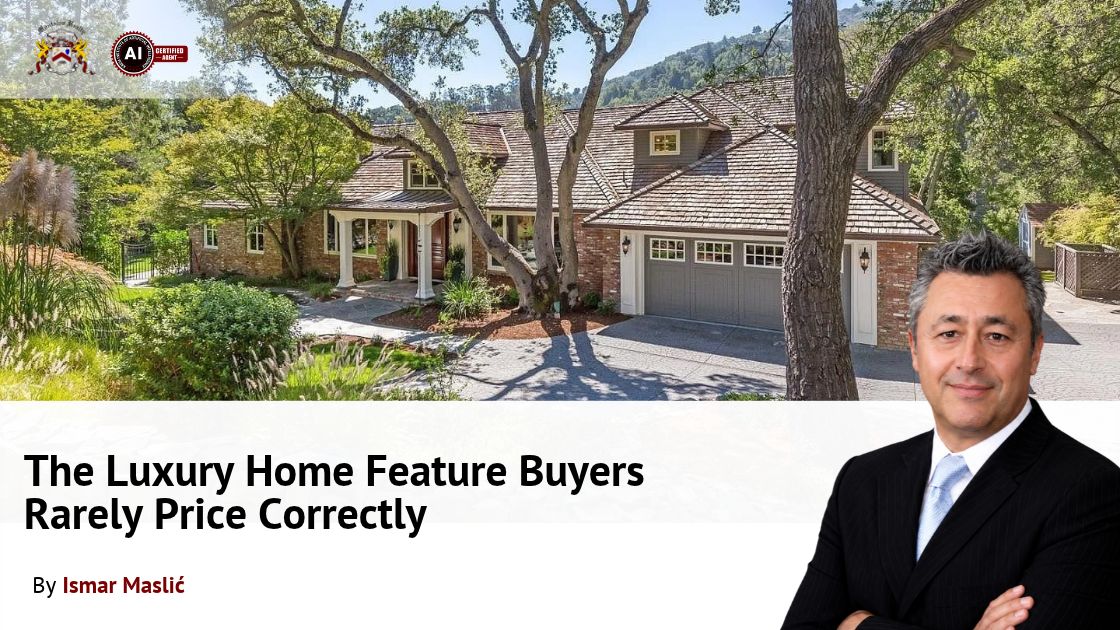
Why Mature Trees Can Be Worth More Than Expensive Landscaping
Luxury buyers notice the obvious things.
The pool. The kitchen. The architecture. The view.
But some of the most valuable features of an established Saratoga, Los Gatos, or Monte Sereno property may have been growing quietly for fifty—or even a hundred—years.
Mature trees.
A magnificent oak framing an estate, a canopy that screens neighboring homes, or established trees creating a shaded garden can completely change how a property feels.
And unlike a kitchen remodel, you can’t simply order another fifty years of growth.
A $100,000 LANDSCAPE ISN’T THE SAME AS A 50-YEAR-OLD LANDSCAPE
Imagine two otherwise comparable luxury homes.
One has just completed an expensive landscaping project. Everything is immaculate: new hedges, ornamental trees, lighting, irrigation and hardscape.
The other has mature trees forming a natural canopy over the property.
Which landscape is more valuable?
The new landscape may actually have cost more.
But the established property possesses something money has difficulty accelerating:
time.
You can install a beautiful young tree tomorrow.
You can’t install the decades it takes for that tree to become part of the architecture.
TREES CAN CREATE ARCHITECTURE WITHOUT WALLS
The best mature landscaping doesn’t merely decorate a property.
It creates spaces.
A row of established trees can form a privacy wall.
A large oak can create an outdoor ceiling.
Trees positioned around a driveway can transform the arrival experience.
A canopy surrounding a pool can make neighboring homes virtually disappear.
That’s why I don’t necessarily evaluate mature landscaping as something separate from the house.
On exceptional properties, the landscape becomes part of the architecture.
THE PRIVACY VALUE
This is particularly important in neighborhoods where multi-million-dollar homes sit relatively close together.
Imagine a backyard surrounded by newly planted five-foot hedges.
Now imagine the same backyard protected by twenty-foot mature screening.
The lot hasn’t become larger.
But emotionally, it can feel significantly more private.
Mature vegetation can help:
- Screen neighboring structures
- Soften second-story sightlines
- Separate outdoor entertaining areas
- Frame attractive views
- Hide utility areas
- Reduce visual exposure from the street
That can create something luxury buyers consistently value:
the feeling of having more land than they actually own.
BUT THE WRONG TREE CAN BECOME AN EXPENSIVE PROBLEM
Mature trees aren’t automatically assets.
A poorly positioned or unhealthy tree can become a significant liability.
Roots may interfere with hardscape, foundations, drainage or underground infrastructure. Branches can threaten roofs or structures. Dense vegetation can affect sunlight and views.
And in hillside or wildfire-prone areas, vegetation management becomes particularly important.
Depending on the property and jurisdiction, protected-tree rules can also affect what an owner may remove or substantially alter.
That’s why the right question isn’t:
“Does this property have mature trees?”
It’s:
“Are these the right mature trees in the right places?”
THE TREE THAT OWNS THE REMODEL
Here’s where buyers can get surprised.
You purchase an older home intending to substantially expand it.
The lot appears large enough.
The conceptual addition looks straightforward.
Then an important mature tree sits exactly where the new construction needs to go—or its protected root zone affects the proposed footprint.
Suddenly, the tree isn’t simply landscaping.
It’s part of the development equation.
Before assuming a major renovation or expansion is feasible, buyers should understand the property’s trees alongside setbacks, easements, zoning and other development constraints.
Future optionality matters.
THE SHADE vs. SUNLIGHT TRADE-OFF
Trees can also create competing forms of luxury.
That magnificent canopy might keep a terrace cooler during summer.
But it may also make the kitchen darker.
Trees may provide extraordinary privacy while blocking a valley view.
They can make a backyard feel established and romantic while reducing sunlight around a pool.
There isn’t always a correct answer.
The goal is balance.
The strongest properties use mature landscaping to frame the architecture rather than overwhelm it.
BROKER’S PERSPECTIVE
LOOK AT WHAT WOULD TAKE DECADES TO REPLACE
When I evaluate an older luxury property, I mentally separate its features into two categories.
Things I can change relatively quickly:
- Paint
- Flooring
- Fixtures
- Appliances
- Kitchens
- Bathrooms
And things that may take decades—or may never be reproducible:
- Lot position
- Views
- Privacy
- Neighborhood
- Mature landscaping
- Exceptional trees
That’s why a dated house on a beautifully established property deserves a second look.
The kitchen might need six months.
The landscape may have needed sixty years.
THE RESALE QUESTION
There’s no sensible formula that says a mature oak automatically adds a specific dollar amount to a property’s value.
But buyers respond to the environment trees create.
They can influence:
- Privacy
- Shade
- Curb appeal
- Outdoor usability
- Architectural character
- First impressions
- Perceived lot quality
- Emotional attachment
And those characteristics can affect how one luxury property competes against another.
The tree itself isn’t necessarily the premium.
The experience it creates may be.
THE BOTTOM LINE
Luxury real estate often celebrates things that are new.
New kitchen.
New pool.
New architecture.
New finishes.
But some of the most compelling properties in Saratoga, Los Gatos and Monte Sereno derive their character from exactly the opposite.
Things that have been there for decades.
So when touring an established estate, don’t just look at the house.
Look up.
Because sometimes one of the property’s most irreplaceable luxury features isn’t inside the residence at all.
It’s been growing outside it for half a century.